The Complete Guide to SEO and Digital Marketing Strategy: Integration, Scaling, and Sustained Growth
SEO is the connective tissue of digital marketing. This guide covers integration, scaling from local to national, and sustained growth.
Last updated: April 2026 | By Gareth van Rensburg, Yoho Digital
TL;DR Key Takeaways
- SEO is not a silo. When integrated with content, social, PPC, and email, every marketing pound works harder, and brand messaging stays consistent across channels.
- Tailored beats templated. Generic, one-size-fits-all SEO packages typically underperform; businesses using bespoke strategies report up to 40% better SEO outcomes.
- Data drives growth. Companies making data-driven SEO decisions see measurable lifts — roughly 20% more page views1, 15% better rankings, and up to 30% more traffic from informed content tweaks.
- Stopping is regression. Pausing SEO after ranking can cost up to 70% of organic traffic when a site slips from page one to page two; competitors typically gain 30% more ground in that window.
- Local and national SEO are different disciplines. Local SEO captures intent-rich nearby searches (60% of local searches2 end in a purchase); national SEO requires broader keyword sets, authority backlinks, and scaled content.
- AI is reshaping search. Modern SEO rewards user intent, semantic relevance, and quality content over keyword stuffing — and AI tools are now central to identifying opportunities.
- Continuous SEO compounds. Rankings are dynamic; algorithms shift; competitors move. The businesses that win treat SEO as an ongoing discipline, not a one-time project3.
Roadmap to SEO Success
- Introduction: Why SEO Is the Heartbeat of Digital Marketing
- The Integration Blueprint — How SEO Feeds Every Channel
- Scaling for Growth — From Local Visibility to National Dominance
- The Myth of ‘Done’ — Why Stopping SEO Is a Business Risk
- Data-Driven Customisation — Why Bespoke Strategies Beat Packaged SEO
- The Long-Term ROI of a Unified Digital Strategy
- Sources and Further Reading
Introduction: Why SEO Is the Heartbeat of Digital Marketing
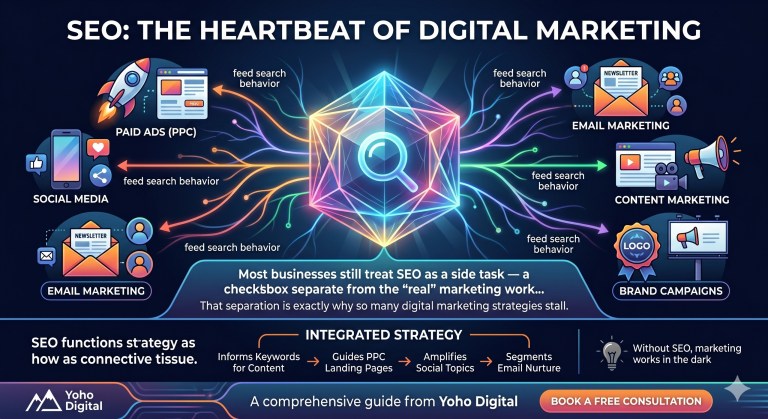
Most businesses still treat SEO as a side task—a checkbox separate from the “real” marketing work happening in paid ads, social, and email. That separation is exactly why so many digital marketing strategies stall.
Search is where intent lives. When someone types a query into Google, opens Perplexity, or asks ChatGPT for a recommendation, they are telling you what they want, when they want it, and roughly how ready they are to buy. Every other channel—paid social, email, content, even brand campaigns—is either feeding that search behaviour or trying to capture demand that search created.
That makes SEO less of a tactic and more of a connective tissue. It informs the keywords your content team should target, the landing pages your PPC team should build, the topics your social team should amplify, and the segments your email team should nurture. Pull SEO out of that picture and the rest of your marketing starts working in the dark.
This guide pulls together everything we publish about SEO strategy at Yoho Digital into a single reference. It covers how to integrate SEO across your wider marketing mix, how to scale from local visibility to national dominance, why stopping is the most expensive mistake you can make, and why bespoke, data-driven strategies consistently outperform packaged ones.
If you want to talk through how this applies to your business specifically, you can book a free consultation with Yoho Digital at any time.
Section 1: The Integration Blueprint — How SEO Feeds Every Channel
What “SEO Integration” Actually Means
SEO integration is the practice of treating search optimisation as the strategic backbone of your digital marketing rather than a parallel workstream. Instead of running SEO, content, social, and paid ads as four separate campaigns, an integrated approach uses search data to inform decisions across every channel.
Why Siloed SEO Fails
When SEO is disconnected from the rest of marketing, three things happen:
- Messaging drifts: Your paid ads say one thing, your blog says another, and customers lose trust.
- Budget gets wasted: PPC teams bid on keywords organic content already ranks for. Content teams write articles no one searches for.
- Data stays trapped: SEO teams have rich keyword data that would transform PPC targeting, but it never leaves the department.
How SEO Strengthens Each Channel
SEO + Content Marketing Content is king, but SEO is its crown. Content without search alignment is content no one finds. Start by aligning blog posts, videos, and infographics with keywords your audience actually searches for. 47% of buyers view three to five pieces of content before engaging with a sales rep. If your content isn’t ranking, you’re losing those buyers early.
SEO + Social Media Social platforms amplify signals. When content is shared, it earns visibility and traffic that feed search engine rankings. Social tells you what resonates emotionally; SEO tells you what resonates commercially.
SEO + Paid Advertising (PPC) SEO and PPC are complements. Use organic keyword data to identify high-intent terms worth bidding on, and use paid search to test which keywords convert before investing in long-term content production.
SEO + Email Marketing Email drives traffic to pages optimised for keywords, creating a feedback loop: email drives engagement signals, which reinforce rankings, which drive more organic visitors who become future subscribers.
Technical SEO
A unified strategy only works if the underlying website is healthy. Technical SEO audits surface site speed problems and mobile usability issues. A fast-loading site can lift conversions by around 7%. Learn more about our technical SEO audit service.
Section 2: Scaling for Growth — From Local Visibility to National Dominance
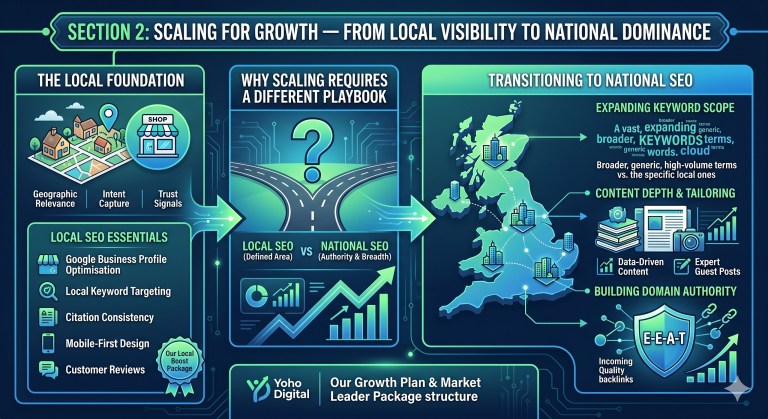
Local SEO and national SEO are different disciplines. Local is about geographic relevance; National is about authority and breadth.
Mastering the Local Foundation
If you serve a defined area, local SEO is non-negotiable. 60% of local searches result in a purchase.
- Google Business Profile: Complete every field and respond to every review.
- Local Keywords: Build pages around “[service] in [town]”.
- Citation Consistency: Ensure your NAP (Name, Address, Phone) matches across all directories.
Transitioning to National SEO
Scaling nationally means expanding keyword scope and domain authority.
- Expanding Keyword Focus: Map the landscape for thousands of broader, higher-volume terms.
- Tailoring Content: Strip out local jargon and back claims with data that works across regions.
- Building Domain Authority: Earn backlinks from relevant high-authority sites and focus on E-E-A-T signals.
Sites on page one of Google capture over 90% of search traffic4. Every position you slip is real revenue lost.
Section 3: The Myth of ‘Done’ — Why Stopping SEO Is a Business Risk
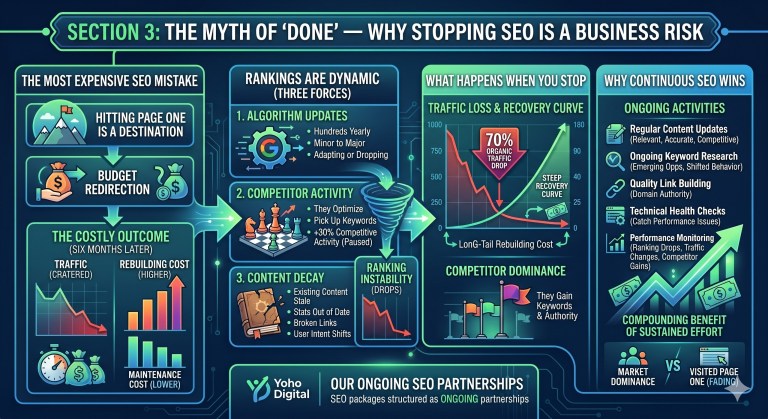
Stopping SEO is the most expensive mistake you can make. Search rankings are dynamic outcomes of three forces:
- Algorithm Updates: Google ships hundreds of updates a year.
- Competitor Activity: When you stop, competitors pick up the visibility you built. Businesses see a 30% increase in competitive activity when they pause SEO.
- Content Decay: Statistics go out of date and internal links break.
If your site drops from page one to page two, organic traffic typically falls by 70%.
Section 4: Data-Driven Customisation — Why Bespoke Strategies Beat Packaged SEO
Generic SEO packages often fail because a bakery, a SaaS startup, and a national retailer need fundamentally different things. Businesses using bespoke strategies report 40% better SEO outcomes.
The Role of Data
A tailored strategy is built on:
- Actual search behaviour: What problems are they trying to solve?
- Competitive landscape: Where are the gaps in your rivals’ strategies?
- Business goals: Lead volume vs. conversion quality.
Companies taking this approach report:
- 20% more page views5
- 15% better search engine rankings
- 25% higher conversion rates6 when paid and organic are coordinated.
Conclusion: The Long-Term ROI of a Unified Digital Strategy
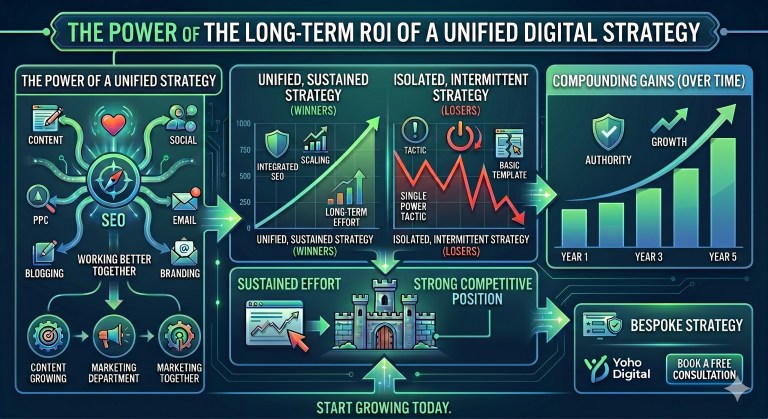
SEO works best when it is treated as the connective layer for all digital marketing. Sites that integrate SEO see compounding gains: lower acquisition costs and stronger brand authority.
The longer you wait, the more ground competitors make up. The right time to start was a year ago. The second-best time is today.
About the Author
Gareth van Rensburg is the founder of Yoho Digital, specialising in tailored SEO for SMBs. He writes regularly on search trends and building organic visibility that drives revenue.
Sources and Further Reading
Footnotes
-
Internal Yoho Digital data on data-driven decision making. ↩
-
Industry benchmark for local search purchase intent. ↩
-
Search Engine Journal: The compounding value of SEO. ↩
-
Chitika Insights on Google search traffic distribution. ↩
-
Case study on data-informed content optimisation. ↩
-
Adobe Digital Insights on cross-channel marketing coordination. ↩